Single parenthood
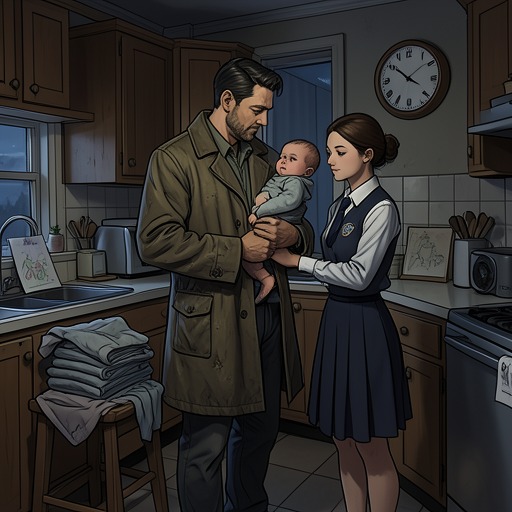
It Must Be Love: A Mustang Prairie RomanceSingle parenthood is the organizing condition of Jack Thorpe’s life in Mustang Prairie. Raising Abby Thorpe and Andie Thorpe without their mother present, he must combine emotional care, discipline, household management, and protection with the unresolved grief and resentment left by his marriage to Marissa Thorpe. The condition makes Jack cautious about intimacy, yet the same family responsibilities draw him toward Trixie Beaumont and toward a broader, more flexible understanding of home.
Identity and Daily Responsibility
Jack’s single-parent identity is stated most clearly when he explains that he needs peace in his life “as much as a single father of two beautiful little girls could get.” His fatherhood is not a passing circumstance but the framework through which he judges every new attachment. He worries about what is suitable for his daughters, including whether Abby should spend time in a shop filled with lingerie, and he tries to set boundaries even while Abby responds by ignoring him and retreating upstairs. Her silence frustrates him because it resembles the emotional distance he associates with Marissa, but it also reveals how seriously he takes his responsibility to repair the unhappiness within his household.
That responsibility is practical as well as emotional. When Trixie arrives at Jack’s home, she finds him preparing a jar of sauce and pasta for the girls. His method is serviceable rather than nourishing, and Trixie takes over by pulling a heavy black skillet forward and calling for onion, garlic, and bell pepper. The scene exposes the ordinary labor behind Jack’s household: he feeds the children and keeps the routine moving, but Trixie recognizes that survival is not the same as teaching them to appreciate whole foods. Single parenthood therefore appears through small domestic compromises, where the parent’s limited time and energy shape what the children receive.
Parenting as a Family System
Jack’s parenting is also a continuous effort to mediate between his daughters’ needs and the adults around them. He recognizes that Jonquil Spring, despite being exceptionally intelligent and college-bound, wants help becoming more socially ordinary. Because Jack has two daughters who can offer different forms of companionship, he proposes bringing Jonquil and Trixie to dinner. He specifically sees Abby as the ideal bridge because she has never met a person she could not befriend. His response to Jonquil is thus not merely romantic or charitable; it is an attempt to use the family’s existing bonds to help another young person find a place within ordinary social life.
The household expands further during Thanksgiving. For the first time since his daughters were babies, Jack has a full house: his parents remain in town, Sadie and Dylan bring side dishes, Luna arrives with a ham, Jonquil comes early with Abby and Andie, and the family gathers around the preparation and traditions of the meal. Trixie arrives only ten minutes before they sit down, having apparently delayed her arrival to avoid Jack. Even so, her presence becomes part of the household’s emotional structure. She and Sadie put away leftovers and clean the kitchen while the others entertain the girls, making the domestic work that sustains the gathering visible.
The result briefly changes Jack’s sense of himself. Watching the family together, he feels happy, light, and free—an emotional state he has not experienced since before his art career took off. His question about where Trixie has gone shows that she has become inseparable from this new feeling of fullness. When she steps outside beneath the stars, Jack follows with a flannel blanket and a thermos, turning care into a quiet gesture of pursuit. The single-parent household is no longer closed around Jack and his daughters; it is becoming a communal arrangement in which friends, grandparents, and chosen family participate.
Marriage, Grief, and Fear of Repetition
Jack’s resistance to relationships grows directly from his account of marriage. He tells Dylan that, despite what everyone believes, his marriage was not good and that he is unwilling to repeat it. When Dylan suggests dating women outside Mustang Prairie, Jack cannot accept the solution because, after being with Trixie, no other woman seems adequate. The contradiction is central: he desires Trixie specifically while rejecting the commitment that might make the relationship secure.
Jack later states the rule more absolutely: he is unwilling to commit “at all.” He wants to avoid the drama of another marriage and protect the peace available to a single father. Yet his refusal is not emotional indifference. His inability to imagine another woman after Trixie shows that the language of casualness functions as a defense against the depth of his attachment. His mother identifies the deeper obstacle when she tells him that Trixie is competing with a ghost. Marissa remains present not simply as a memory but as the comparison against which Trixie and Jack’s future are measured.
The family’s history therefore complicates Jack’s parenting. Abby resembles her mother enough that people in Mustang Prairie often treat her as Marissa’s ghost rather than as an individual child. Trixie helps Abby resist that reduction by telling her that people are drawn to her not only because of her appearance but because she possesses Marissa’s ability to pull people toward her. She then sits beside Abby and teaches her how to tie off her work. The moment joins emotional reassurance with instruction: Trixie acknowledges the inheritance of Marissa’s presence while giving Abby a separate, tangible identity as a child learning a skill.
Children as Agents of Reconciliation
Jack’s daughters do not merely receive his care; they interpret the adults’ conflict and intervene in it. On Christmas, Andie tells Jack that he only needs to apologize because girls like it when boys apologize for hurting their feelings. When he asks who has hurt her, she answers that many people have and insists that she is nearly a teenager and can handle it. She then holds his face in her hands and tells him to apologize to Trixie, adding that she and Abby know he likes her.
This exchange makes the children the emotional truth-tellers of the family. Jack can describe his position as a principled refusal of commitment, but the girls recognize the visible attachment beneath it. Their intervention does not erase the history of his marriage or force an outcome, but it challenges the idea that protecting the household requires emotional withdrawal. In the single-parent family, the children become participants in the work of reconciliation, translating adult feeling into a demand for accountability.
Change and Narrative Significance
Jack begins from a model of single parenthood defined by containment: he must manage two daughters, preserve peace, and prevent another failed marriage. His routines are marked by limits, from practical meals to arguments over where Abby should spend time. But repeated encounters with Trixie, Jonquil, and the wider community expose the insufficiency of that closed model. Trixie contributes comfort, food, instruction, and domestic labor; Jonquil is invited into the girls’ social world; grandparents and friends fill the Thanksgiving house; and the children themselves press Jack toward honesty.
The significance of single parenthood in Jack’s story lies in this movement from solitary endurance to shared care. It explains his caution without reducing him to a wounded widower or an unavailable lover, because his refusal of commitment is continually tested by the family life he is already building. The household’s emotional future depends not on abandoning fatherhood but on recognizing that care can be distributed across biological family, friendship, community, and romantic possibility. Jack remains responsible for Abby and Andie, but the narrative increasingly presents that responsibility as a foundation for connection rather than a reason to remain alone.